Automatic Field Type Management
JSON doesn't have a strong type system. An amount field might arrive as 15000 in one event and "15000" in the next, depending on the source system. When a rule does $amount > 10000, the result depends entirely on which one shows up — and string comparison produces different ordering than numeric comparison. "9999" > "10000" is True lexicographically. That's backwards.
The usual fix is to cast inside the rule:
Which works until the next person writes a rule without the cast. Now you have inconsistent behavior across the rule set with no easy way to audit it.
ezrules v0.12 handles this at the engine level.
How it works
Every event that passes through /api/v2/evaluate is observed. For each field in the payload, we record the JSON type Python saw — int, float, str, bool. The same happens in the Test Rule panel, so observations build up during development without needing live traffic.
The observations show up under Settings → Field Types:
Two rows for amount means it arrived with two different types. That's a data quality signal worth investigating, but you don't have to wait — configure amount as float and both variants are handled correctly from that point on.
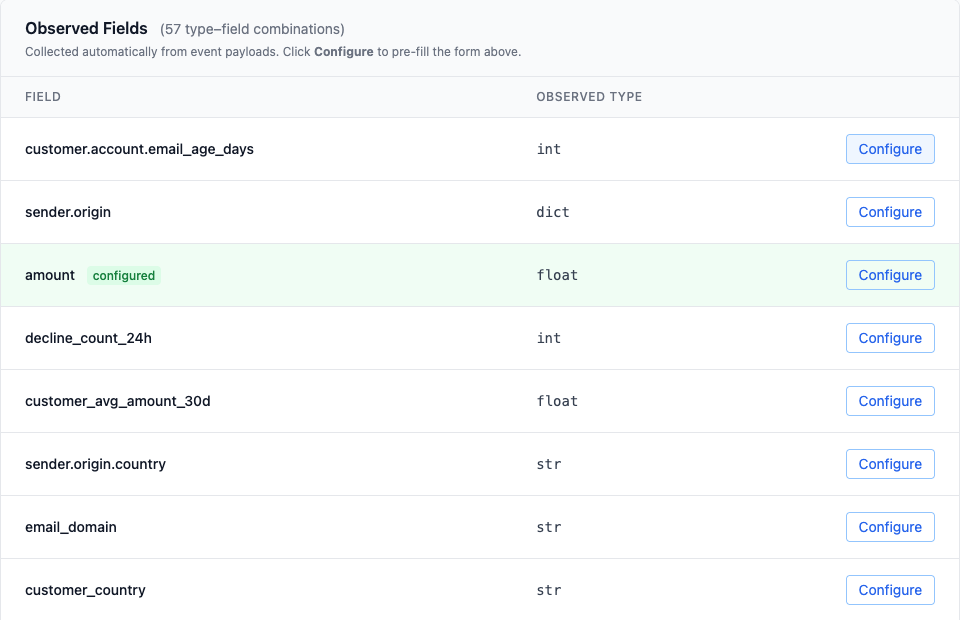
From the same page, click Configure next to any observation, pick the type, save. For datetime fields you also provide a format string (%Y-%m-%dT%H:%M:%S), and the value will be parsed into a proper datetime object before rules run.


After that, the rule stays as written:
The comparison is always numeric. No casts inside rules, no special handling per field.
If a value can't be cast — say amount is "not-applicable" and the configured type is float — evaluation returns a 400 with the specific field and value that failed. That's better than a silent wrong answer.
What this doesn't do
It doesn't fix upstream data quality. If your source sends malformed values you'll find out faster (hard failure rather than incorrect evaluation), but you still have to fix the source.
It's also not a replacement for schema validation at ingestion if you need that. The scope here is making rule comparisons correct without requiring every rule author to remember casting.
Audit trail
Every field type configuration change is recorded — who changed it, when, and what the previous value was. If amount gets changed from integer to float and evaluation behavior shifts, you can trace it directly. Available at GET /api/v2/audit/field-types or in the Audit Trail page under Field Type History.